"Of all things the measure is Man, of the things that are, that they are, and of the things that are not, that they are not."Protagoras, as quoted by Plato, Protagoras or the Sophists
"It is believed that one cannot be more than man. Rather, one cannot be less!"Max Stirner, The Ego and Its Own
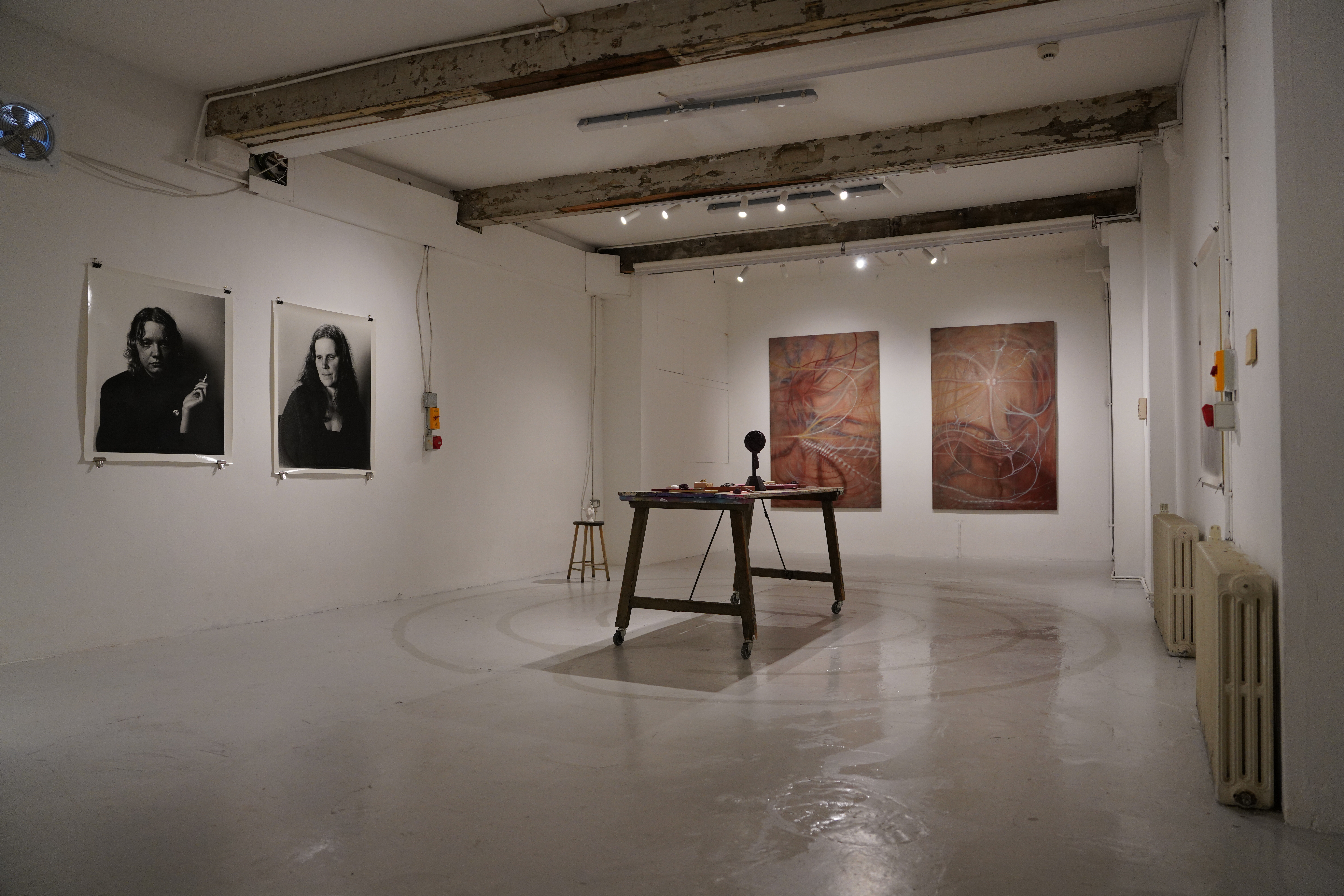
the measure of all things (and those that are not) presents the work of Isabelle Zetterström, Lucia Rossi, Ewelinka Dochan, and Theodore Wilkins-Lang, curated by COMEDY OF MENACE and Marta Przygodzka. The exhibition also marks the first activity of a collective curatorial platform, Broncho Bianchi, at Apiary Studios, run by the collective and Przygodzka. Welcome to the housewarming.
In Plato's dialogue with Protagoras, the latter is cast as an exponent for relativism, that all knowledge and experience is subjective. But this thought, homo mensura ("man the measure") as it has been called, also set the stage for the further development of anthropocentrism, casting "Man" or "the human" as the measuring stick for all things that are (and are not). Here, the entirety of the cosmos becomes a sandbox for "Man," its (self-appointed) ruler. The pun is intended: we talk here of both tool and tyrant. Take how the use of feet and inches as measurement units, anthropometry, converged in the inscription of the king's body in the medieval French pied du roi unit of measure, the "king's foot", which standardised measurement to the (symbolic) scale of the ruler until the 1790s. Asides from what we may call its convenience, it has served as a rationalist backbone for arguments for "human" superiority, and thus for defining "humanity" as conforming to the scales and measures of (an) idealised "Man," leading both to romantic ideals of divine purpose and pseudoscientific atrocities such as phrenology, racial science and eugenics.
But we digress. As you already know, weirder shit is going on than what inches and feet can hold on or step to. If "man" is the measure of all that is (and isn't), we stress here all the ways in which this unit can only burst: as a faulty container of all that exceeds "us." Gaze here into that warped mirror; where the measure, the scale, the ruler has no more to hold. The center snaps.
Isabelle Zetterström
Isabelle Zetterström's practice emerges from a painterly and sculptural language of Gothicized abstraction. Her works sit within both the tender, yet cold intimacy of a microscope view and fabulating landscapes out of a richly surreal cosmology. Nietzsche's exclamation that "there is no outside!" is here an invitation to think of the strange, unreal and alien so close that they crawl around inside us, and we along them. Not just the, but all world(s) are here a matter very near, so near as almost not to bear.
The diptych Beneath the Veins of Desire hovers like the blown-up insides of an eyeball scan, but the flatness of a medical scan's extrapolation is here replaced with the depth of landscape painting. Here, all is guts: every tone is every sort of fleshy, from the grey-blues and reds of veins seen through skin to the faint whites of cartilage, bodily fluids and bone. Eyes split open, folding outwards and becoming a world themselves, not a distant spectator, but a field of outspread all-guts. It wants the world, ravenously: this gaze seeks to pierce the (world-)flesh until the point of its own rupture, and thus unfolding. Contrasting in both format and execution, Alebra, the name referring to nothing, being more of a sound, is an oil on cotton painting so densely textured it might be more fitting to call it sculpture. Departing from the almost translucent quality of Zetterström's other works, where linen canvases shimmer with repeatedly applied thin layers of paint, the three-dimensionality reorients its related works. This neither ancestor nor descendant is suffused with a mineral, or plaster-like character: a fossil of some earlier stage, or the scarce remnants of a being long lost.
Lucia Rossi
Rossi presents Purpurea, purpurea, PURPUREA, a series of works all derived from intensely/painfully material research circled around the same handheld mirror. The objects on display are all offshoots and process pieces related to her upcoming Degree Show work from the Royal College of Art, which opens shortly after this exhibition concludes. Fragments of a Narcissus story centre on its armature rather than its subject, this is an exercise in baroquely alchemical simulacra-production. The archetypal symbol of both beauty and narcissism is here turned into a sacred relic of the boundness of objects and matter in constituting any phenomenology.
The work situates the grotesque and abject within the beautiful and ornamental. In attempting to render a specific hand-mirror as several full-size casts, then turning their bronze into a deep purple only through the specific chemical reactions inherent in the alloy used, Rossi here goes on a mad quest similar to the alchemical project of completing the Great Work. This obsessive process leads to a literal and allegorical re-casting: both as the sculptural practice of moulding and copying, and the more performative sense of sliding into and out of new roles and modes of being. Rendered in both bronze, wax and plaster, Purpurea, purpurea, PURPUREA dwells within the exhibition space as an unending ("Great") work in progress. The "deformed" remnants of wax casting processes have been overlaid on the mirror itself, parasitically highlighting its duplicitous role as both reflector and distorter. Here, you look upon not a copy within a shimmering flat surface, but an unsteady, waxily trickling extension out of the "picture plane" that usually drags you in.
Theodore Wilkins-Lang
Theodore Wilkins-Lang works through the materiality of the photographic process understood as holy. Realised in single-edition, large-format darkroom prints, his practice is meticulous, ritualistic, and references iconic imagery in the devotional presentness that Wilkins-Lang situates in the everyday encounter.
The current exhibition brings together works from across three series, tracing a study of the materiality of the unknown. An early large-format work, Laura speaks to a strive for an existentialist photography where one discovers the conditions of their existence in the Other. Icon of Theia Sophia marks an increasing fascination with icon-building in Wilkins-Lang's practice, anchoring the divine through light as the sacred substance of reality and the material of photography. It is a portrait of the artist's mother, formerly a reverend in the Church of Scotland, and stems from a conversation on Sergei Bulgakov's sophiology and the wider doctrinal exclusion of conceptions of a divine feminine. Revelation is a record of the light that suffused an unopened box of large format high speed infrared film in the years between its manufacture in the 1980s and 2025, when the work was concluded by Wilkins-Lang, it concludes the triptych on show.
Ewelinka Dochan

Ewelinka Dochan's work builds upon a rigorous understanding of academic formalism and standardisation to establish itself in a practice of unfixing emulation. Casts made from the body are means of measurement, but extend to form a record of transience and decay for the artist, who sees them as archives of the self. Dochan works with plaster, clay, nails, and teeth, gesturing to an interest in the flesh of being and the death-driven abjection at its core. To make Plaster Feet (2024), they lay in a high-density clay bath and cast plaster into the form. The documentation featured in the exhibition traces this merge between traditional mould-making techniques and a performance of birthing and cleaning. The frame marks the artist's renewed interest in developing their recent contemporary responses to ornamental motifs in architectural design, informed by their training in fibrous plastering.
Enquire about the exhibition